PENGARUH MODEL STAD BERBASIS KONTEKSTUAL TERHADAP KEMAMPUAN PEMECAHAN MASALAH MATEMATIS PESERTA DIDIK

Keywords:
STAD, Contextual, Mathematical Problem-SolvingAbstract
ABSTRAK
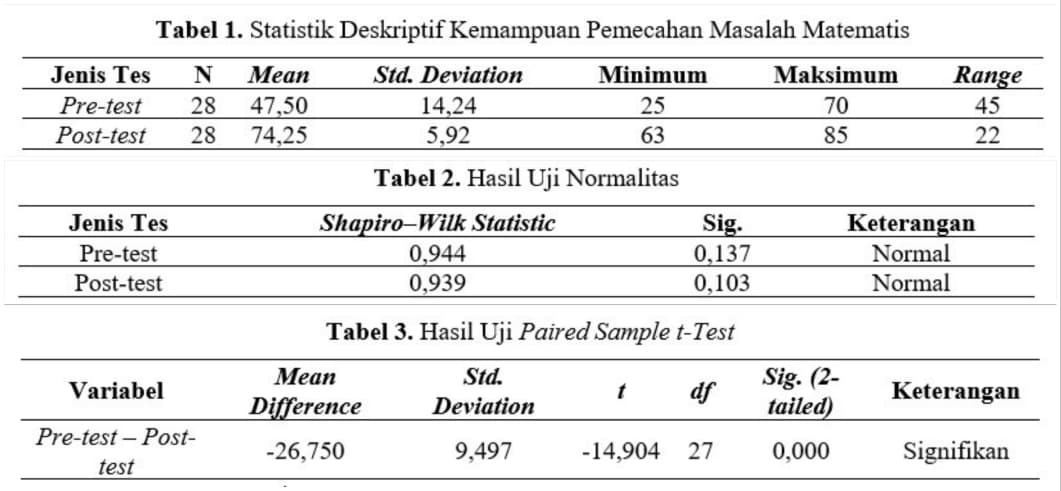
Rendahnya kompetensi peserta didik dalam memecahkan masalah matematis menunjukkan perlunya inovasi model pembelajaran yang lebih efektif dan kontekstual. Tujuan penelitian ini yaitu guna memeriksa seberapa efektif model pembelajaran Division of Student Achievement (STAD) berbasis kontekstual dalam meningkatkan kemampuan peserta didik SMP untuk memecahkan masalah matematis. Penelitian ini dilakukan secara kuantitatif dan menggunakan desain pre-experimental satu kelompok pretest-posttest. Penelitian ini melibatkan peserta didik kelas VII di SMPN 1 Tarowang, dan sampelnya adalah 28 peserta didik kelas VII-2. Alat yang diterapkan pada penelitian ini merupakan tes pemecahan masalah matematis yang didasarkan pada indikator Polya. Hasilnya mengindikasikan bahwa peserta didik memiliki kompetensi yang yang semakin optimal guna mengatasi masalah matematis, seperti yang ditunjukkan oleh skor rata-rata posttest yang lebih tinggi dibandingkan dengan skor pretest, uji paired sample t-test menunjukkan nilai signifikansi di bawah 0,05, sehingga H0 ditolak, artinya ada perbedaan yang signifikan kemampuan pemecahan masalah matematis peserta didik sebelum dan sesudah pembelajaran STAD berbasis kontekstual. Selain itu, perhitungan ukuran efek menunjukkan kategori tinggi. Temuan ini menandakan bahwa model STAD berbasis kontekstual efektif dalam meningkatkan kemampuan peserta didik untuk menyelesaikan masalah matematis. Model STAD berbasis kontekstual bisa dipakai sebagai model pembelajaran alternatif demi meningkatkan kemampuan berpikir tingkat tinggi.
ABSTRACT
The low competence of students in solving mathematical problems indicates the need for innovative, effective, and contextual learning models. The purpose of this study was to examine the effectiveness of the Division of Student Achievement (STAD) model based on contextual learning in improving junior high school students’ mathematical problem-solving abilities. This research employed a quantitative approach with a pre-experimental design using a one-group pretest-posttest. The study involved seventh-grade students at SMPN 1 Tarowang, with a sample of 28 students from class VII-2. The instrument used in this research was a mathematical problem-solving test based on Polya’s indicators. The results indicated that students demonstrated improved competence in solving mathematical problems, as evidenced by higher posttest mean scores compared to pretest scores. The paired sample t-test showed a significance value below 0.05, leading to the rejection of the H0. This indicates a significant difference in students’ mathematical problem-solving abilities before and after the contextual-based STAD learning. Furthermore, the effect size calculation showed a high category. These findings suggest that the contextual-based STAD model is effective in enhancing students’ ability to solve mathematical problems. The contextual-based STAD model can serve as an alternative learning model to promote higher-order thinking.
Downloads
References
Abida, A. S., Suyitno, A., & Kharisudin, I. (2023). Analisis Kemampuan Pemecahan Masalah Siswa dalam Pembelajaran Creative Problem Solving Berbantuan Modul Pembelajaran. Histogram: Jurnal Pendidikan Matematika, 7(2), 244–265. https://journal.matappa.ac.id/index.php/histogram/article/view/3456
Alwi, A., Tabina, A. R., Aziza, N. A., Azmira, R., Putri, R. J., Lubis, M. R., & Nasution, S. H. (2023). Pembelajaran Kooperatif: Meningkatkan Pemahaman, Keterampilan Sosial, dan Motivasi Belajar Siswa. Cognoscere: Jurnal Komunikasi dan Media Pendidikan, 1(2), 1–6. https://doi.org/10.61292/cognoscere.97
Amirudin, J., Ruswandi, U., Erihadiana, M., & Rohimah, E. (2022). Implementation of the CTL Learning Model Through Islamic Moderate Values in Improving the Attitude of Students’ Tolerance in School. Nazhruna: Jurnal Pendidikan Islam, 5(2), 690–703. https://doi.org/10.31538/nzh.v5i2.2201
Arico, V. D., & Wahyudi, W. (2021). Pelevelan Kemampuan Pemecahan Masalah Matematis Berdasarkan Taksonomi Solo. JISIP (Jurnal Ilmu Sosial dan Pendidikan), 5(1), 418–423. https://doi.org/10.58258/jisip.v5i1.1747
Arnidha, Y., & Fatahillah, F. (2021). Membentuk Karakter Logis, Kritis, Kreatif dan Inovatif dalam Pembelajaran Matematika melalui Pendekatan Saintifik. Jurnal E-DuMath, 7(1), 35–41. https://doi.org/10.52657/je.v7i1.1359
Boru, M. A., & Saingo, Y. A. (2025). Model Cooperative Learning sebagai Pendekatan Mengajar yang Alkitabiah untuk Meningkatkan Kerja Sama Siswa. Sinar Kasih : Jurnal Pendidikan Agama dan Filsafat, 3(2), 65–78. https://doi.org/10.55606/sinarkasih.v2i2.333
Cohen, J. (1988). Statistical Power Analysis for the Behavioral Sciences. Lawrence Erlbaum Associates.
Desai, R. (2024). Using STAD asan Assessment for Learning (AfL) in Mathematics. Journal of Engineering Education Transformations, 37, 993–997. https://doi.org/10.16920/jeet/2024/v37is2/24150
Fauziah, N., Roza, Y., & Maimunah, M. (2022). Kemampuan Matematis Pemecahan Masalah Siswa dalam Penyelesaian Soal Tipe Numerasi AKM. Jurnal Cendekia: Jurnal Pendidikan Matematika, 6(3), 3241–3250. https://doi.org/10.31004/cendekia.v6i3.1471
Hasanah, Z., & Himami, A. S. (2021). Model Pembelajaran Kooperatif dalam Menumbuhkan Keaktifan Belajar Siswa. IRSYADUNA: Jurnal Studi Kemahasiswaan, 1(1), 1–13. https://doi.org/10.54437/irsyaduna.v1i1.236
Heebkaew, C., & Seehamongkon, Y. (2024). The Development of the Ability to Solve Mathematical Problems and Academic Achievement Decimal Problem of Prathomsuksa Students Through Cooperative Learning Management STAD and KWDL Technique. Journal of Education and Learning, 13(1), 150–161. https://doi.org/10.5539/jel.v13n1p150
Hendriani, M., & Gusteti, M. U. (2021). Validitas LKPD Elektronik Berbasis Masalah Terintegrasi Nilai Karakter Percaya Diri untuk Keterampilan Pemecahan Masalah Matematika SD di Era Digital. JURNAL BASICEDU, 5(4), 2430–2439. https://doi.org/10.31004/basicedu.v5i4. 1243
Inayah, F., & Agoestanto, A. (2023). Kemampuan Pemecahan Masalah Ditinjau dari Resiliensi Matematis: Tinjauan Pustaka Sistematis. JUMLAHKU Jurnal Matematika Ilmiah Universitas Muhammadiyah Kuningan, 9(1), 74–86. https://doi.org/10.33222/jumlahku.v9 i1.2798
Klang, N., Karlsson, N., Kilborn, W., Eriksson, P., & Karlberg, M. (2021). Mathematical Problem-Solving Through Cooperative Learning the Importance of Peer Acceptance and Friendships. ORIGINAL RESEARCH, 6. https://doi.org/10.3389/feduc.2021.710296
Matondang, K., Matondang, A. R., Saragih, R. M. B., & Maharani, I. (2021). Pengaruh Model Pembelajaran Kontekstual terhadap Kemampuan Pemecahan Masalah. FARABI Jurnal Matematika dan PendidikanMatematika, 4(1), 69–73. https://doi.org/10.47662/farabi.v4i1.72
Muhidin, D., & Kudus, H. H. A. (2022). Upaya Meningkatkan Kemampuan Pemecahan Masalah Matematis dengan Model Pembelajaran Kooperatif Tipe Student Teams Achievement Division. Jurnal At-Tadbir: Media Hukum dan Pendidikan, 32(2), 106–114. https://doi.org/10.52030/attadbir.v32i2.146
Mutaqin, E. J., Suryaningrat, E. F., & Fauziyah, F. (2024). Pengaruh Pendekatan Kontekstual Berbantuan Media Relia terhadap Kemampuan Pemecahan Masalah Matematika Siswa Kelas 2 SDIT Al-Ikhlas Samarang. Caxra Jurnal Pendidikan Dasar, 4(2), 79–88. https://doi.org/10.31980/caxra.v4i2.1076
Odutayo, A. O., & Fonseca, K. (2024). Making Quadratic Functions Interesting: Students Teams-Achievement Division Instructional Strategy. EURASIA Journal of Mathematics, Science and Technology Education, 20(1), 1–11. https://doi.org/10.29333/ejmste/14092
Polya, G. (1957). How To Solve It. Princeton University Press.
Putra, R., Surya, E., Setiawan, D., & Hidayat, H. (2024). Improve High Order Thinking Students through Contextual Teaching Learning Based on Cognitive Distance. International Journal of Religion, 5(11). https://doi.org/10.61707/wpk8d874
Putri, R. N., & Kaivalya, A. (2024). STAD Type Cooperative Learning Style to Improve Students’ Mathematical Abilities. IJSME: International Journal of Science and Mathematics Education, 1(1), 36–43. https://doi.org/10.62951/ijsme.v1i1.15
Rad, H. S., Namaziandost, E., & Razmi, M. H. (2023). Integrating STAD and Flipped Learning in Expository Writing Skills: Impacts on Students’ Achievement and Perceptions. Journal of Research on Technology in Education, 55(4), 710–726. https://doi.org/10.1080/15391523.2022.2030265
Ramadhany, N., Tampa, A., & Upu, H. (2025). Systematic Literature Review: The Effectiveness of Using the Problem-Based Learning Model in Improving Problem-Solving Skills. Mathline: Jurnal Matematika and Pendidikan Matematika, 10(3), 703–717. https://doi.org/10.31943/mathline.v10i3.859
Ranmechai, S., & Poonputta1, A. (2023). Enhancing Measurement Education in Schools: A Study on the Efficacy of STAD (Student Teams Achievement Division) in Undergraduate Mathematics Education. Journal of Curriculum and Teaching, 12(6), 330–337. https://doi.org/10.5430/jct.v12n6p330
Rasid, S. A., Setiani, A., & Imswatama, A. (2025). Pengaruh Model Pembelajaran Student Teams Achievement Division (STAD) dengan Pendekatan Problem Posing terhadap Kemampuan Pemecahan Masalah Matematis. JIPMat (Jurnal Ilmiah Pendidikan Matematika), 10(1), 126–134. https://doi.org/10.26877/2kdh4p79
Ronald, J., Amelia, M., Eprillison, V., Stevani, S., Amaluis, D., Pratama, I. M., & Selvia, N. (2023). CTL and Blended Learning Models in Improving Learning Outcomes. Economica: Journal of Economic and Economic Education, 12(1), 49–54. https://doi.org/10.22202/economica.2023.12.i1.
Suciati, I., Mailili, W. H., & Hajerina, H. (2022). Implementasi Geogebra terhadap Kemampuan Matematis Peserta Didik dalam Pembelajaran: A Systematic Literature Review. Teorema: Teori dan Riset Matematika, 7(1), 27–42. https://doi.org/10.25157/teorema.v7i1.5972
Umbara, H. D. A. D., Suhendra, S., & Jupri, A. (2024). Students’ Mathematical Problem-Solving Ability from the Perspective of Mathematical Anxiety Levels. Mosharafa: Jurnal Pendidikan Matematika, 13(3), 637–648. https://doi.org/10.31980/mosharafa.v13i3.1640
Uya, L. A., Widodo, S., & Katminingsih, Y. (2022). Meta Analisis: Peranan Model Problem Based Learning terhadap Kemampuan Pemecahan Masalah Matematis. Histogram: Jurnal Pendidikan Matematika, 6(1), 84–95. https://journal.matappa.ac.id/index.php/histogram/ article/view/1695
Yapatang, L., & Polyiem, T. (2022). Development of the Mathematical Problem-Solving Ability Using Applied Cooperative Learning and Polya’s Problem-Solving Process for Grade 9 Students. Journal of Education and Learning, 11(3), 40–46. https://doi.org/10.5539/jel.v11n3p40
Zahro, N. F., & Haerudin, H. (2022). Analisis Kemampuan Pemecahan Masalah Peserta Didik dalam Menyelesaikan Soal PISA. Jurnal Didactical Mathematics, 4(1), 148–155. https://doi.org/10.31949/dm.v4i1.2073
Downloads
Published
How to Cite
Issue
Section
License
Copyright (c) 2025 Ernawati, Irmaharniwati, Hamda

This work is licensed under a Creative Commons Attribution-NonCommercial-NoDerivatives 4.0 International License.
Please find the rights and licenses in Histogram: Jurnal Pendidikan Matematika. By submitting the article/manuscript, the author(s) accept this policy.
1. License
The non-commercial use of the article will be governed by the Creative Commons Attribution license as currently displayed on Creative Commons Attribution-ShareAlike 4.0 International.
2. Author's Warranties
The author warrants that the article is original, written by a stated author(s), has not been published before, contains no unlawful statements, does not infringe the rights of others, is subject to copyright that is vested exclusively in the author and free of any third party rights, and that any necessary written permissions to quote from other sources have been obtained by the author(s).
3. User Rights
Histogram: Jurnal Pendidikan Matematika's spirit is to disseminate articles published for free. Under the Creative Commons license, Histogram: Jurnal Pendidikan Matematika permits users to copy, distribute, display, and perform the work for non-commercial purposes only. Users will also need to attribute authors and Histogram: Jurnal Pendidikan Matematika when distributing works in the journal.
4. Rights of Authors
Authors retain all their rights to the published works, such as (but not limited to) the following rights;
- Copyright and other proprietary rights relating to the article, such as patent rights,
- The right to use the substance of the article in one's future works, including lectures and books,
- The right to reproduce the article for one's purposes,
- The right to self-archive the article,
- The right to enter into separate, additional contractual arrangements for the non-exclusive distribution of the article's published version (e.g., post it to an institutional repository or publish it in a book), with an acknowledgment of its initial publication in this journal (Histogram: Jurnal Pendidikan Matematika).
5. Co-Authorship
If other authors jointly prepared the article, any author submitting the manuscript warrants that all co-authors have authorized them to agree on this copyright and license notice (agreement) on their behalf and agree to inform their co-authors of the terms of this policy. Histogram: Jurnal Pendidikan Matematika will not be held liable for anything arising from the author(s) internal dispute. Histogram: Jurnal Pendidikan Matematika will only communicate with the corresponding author.
6. Royalties
This agreement entitles the author to no royalties or other fees. To such an extent that it is legally permissible, the author waives their right to collect royalties relative to the article regarding any use by Histogram: Jurnal Pendidikan Matematika.
7. Miscellaneous
Histogram: Jurnal Pendidikan Matematika will publish the article (or have it published) in the journal if the editorial process is completed. Histogram: Jurnal Pendidikan Matematika h editors may modify the article to a style of punctuation, spelling, capitalization, referencing, and usage that deems appropriate. The author acknowledges that the article may be published to be publicly accessible, and such access will be free of charge for the readers, as mentioned in point 3.