ANALISIS KEMAMPUAN LITERASI NUMERASI SISWA SMK MELALUI SOAL TES KEMAMPUAN AKADEMIK (TKA)
DOI:
https://doi.org/10.31100/histogram.v10i2.4888Keywords:
Numeracy, Academic Ability Test, Vocational High School StudentsAbstract
ABSTRAK
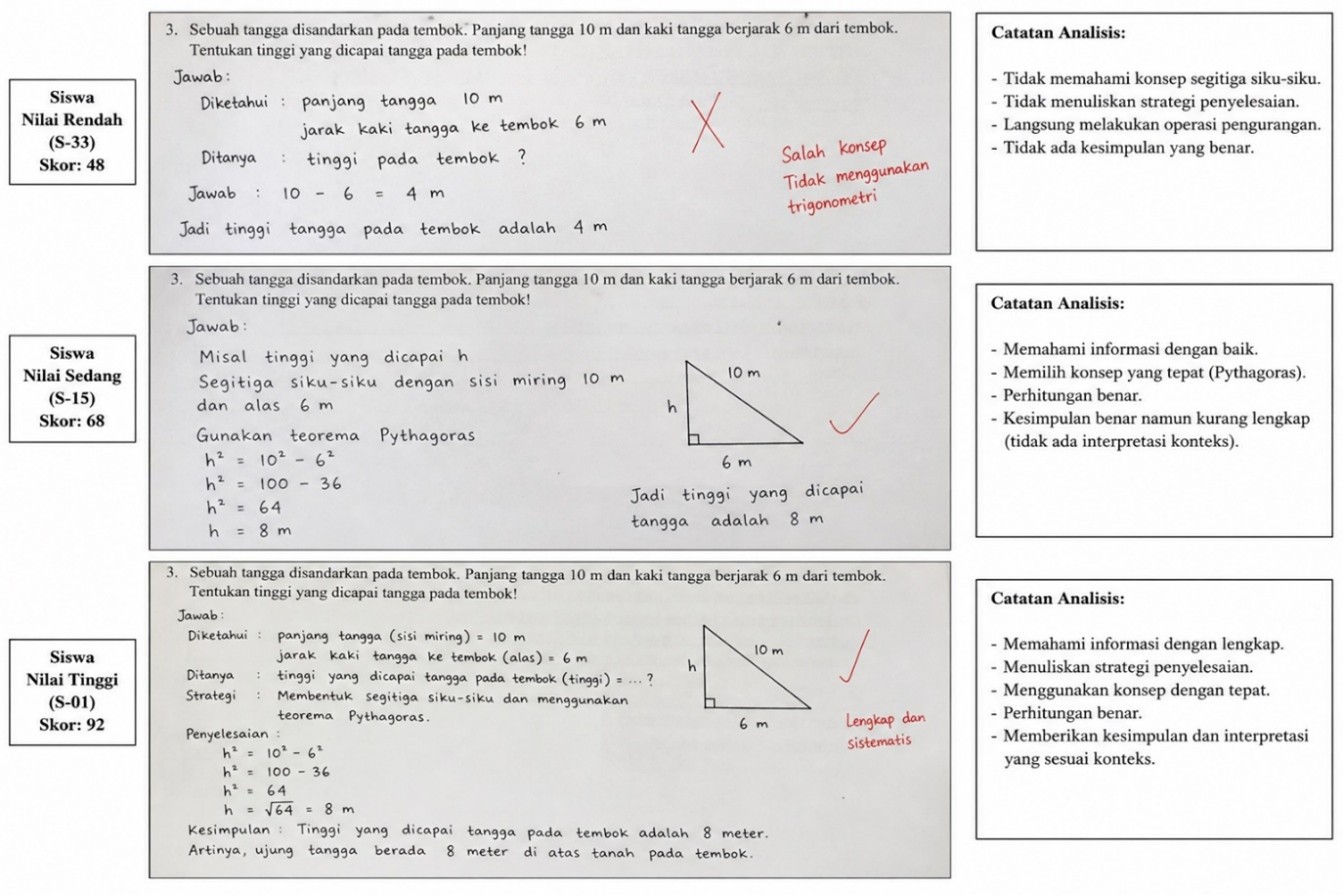
Kemampuan literasi numerasi merupakan salah satu kemampuan penting yang diperlukan siswa dalam memahami informasi kuantitatif, menerapkan konsep matematika, serta mengambil keputusan berdasarkan data dan perhitungan. Pada jenjang Sekolah Menengah Kejuruan (SMK), kemampuan tersebut memiliki keterkaitan dengan kebutuhan pembelajaran maupun kehidupan sehari-hari serta dunia kerja. Penelitian ini memiliki tujuan untuk mendeskripsikan kemampuan literasi numerasi siswa SMK dalam melakukan penyelesaian soal-soal matematika yang dikembangkan dengan karakteristik Tes Kemampuan Akademik (TKA. Penelitian menggunakan pendekatan kualitatif deskriptif dengan penggunaan data kuantitatif sebagai pendukung. Subjek penelitian terdiri atas 35 siswa kelas XII TKJ 2 SMK Raudlatul Malikiyah Probolinggo. Instrumen penelitian berupa lima soal matematika kontekstual yang mencakup materi aljabar, bilangan, geometri dan pengukuran, data, serta trigonometri. Berdasarkan data hasil penelitian, rata-rata kemampuan siswa adalah 71,09. Sebanyak 8 siswa atau 22,86% berkategori tinggi, 20 siswa atau 57,14% berkategori sedang, dan 7 siswa atau 20,00% berkategori rendah. Analisis jawaban menunjukkan bahwa kemampuan memahami informasi relatif lebih baik dibandingkan kemampuan menalar dan menyimpulkan. Kesulitan siswa diketahui ketika siswa harus memilih strategi penyelesaian, menghubungkan beberapa informasi, melakukan evaluasi hasil perhitungan, dan memberikan alasan terhadap kesimpulan. Hasil ini menunjukkan perlunya pembelajaran matematika yang lebih banyak menggunakan permasalahan kontekstual.
ABSTRACT
Numeracy is an important skill that enables students to understand quantitative information, apply mathematical concepts, and make decisions based on data and calculations. At the vocational high school level, this skill supports academic learning, everyday life, and the workplace. This study aimed to describe the numeracy skills of vocational high school students in solving mathematics problems developed based on the characteristics of the Academic Ability Test (TKA). The study employed a descriptive qualitative approach supported by quantitative data. The participants consisted of 35 Grade XII students from Class TKJ 2 at SMK Raudlatul Malikiyah Probolinggo. The research instrument consisted of five contextual mathematics problems covering algebra, numbers, geometry and measurement, data, and trigonometry. The results showed that the students obtained a mean score of 71.09. Eight students (22.86%) were categorised as high, 20 students (57.14%) as moderate, and 7 students (20.00%) as low. Analysis of the students’ responses showed that they understood information better than they could reason and draw conclusions. Students had difficulty selecting appropriate solution strategies, connecting multiple pieces of information, evaluating calculation results, and justifying their conclusions. These findings indicate the need for mathematics instruction that incorporates more contextual problems.
Downloads
References
Amelya, T. D., Wahyuni, T., Ningsih, L. F., & Andriani, U. C. (2025). Kajian Literatur: Hambatan Implementasi Asesmen Kompetensyi Minimum (AKM) Literasi Numerasi di Sekolah Menengah Pertama. CONSISTAN: Jurnal Tadris Matematika, 3(02), 166–185. https://ejournal.alqolam.ac.id/index.php/CONSISTAN/article/view/2262/1330
Ayatullah, A. M., Yuhana, Y., & Sukirwan, S. (2023). Analisis Kesulitan dan Self-Efficacy Siswa SMP dalam Pemecahan Masalah Matematika. Wilangan: Jurnal Inovasi dan Riset Pendidikan Matematika, 4(2), 94–102. https://jurnal.untirta.ac.id/index.php/wilangan/article/view/19588
Badan Standar, Kurikulum, dan A. P. (2025). Peraturan Kepala Badan Standar, Kurikulum, dan Asesmen Pendidikan Nomor 045/H/AN/2025 tentang Kerangka Asesmen Tes Kemampuan Akademik Jenjang SMA/MA/Sederajat dan SMK/MAK. https://pusmendik.kemendikdasmen.go.id/pdf/file-175
Bolstad, O. H. (2023). Lower Secondary Students’ Encounters with Mathematical Literacy. Mathematics Education Research Journal, 35, 237–253. https://doi.org/10.1007/s13394-021-00386-7
Fahmy, A. F. R., Apriliyani, D., Janah, R., & Khoerunnisa, K. (2025). Literasi Numerasi Siswa SMP dalam Menyelesaikan Soal Asesmen Kompetensi Minimum. Circle: Jurnal Pendidikan Matematika, 5(2), 200–217. https://doi.org/10.28918/circle.v5i2.12409
Fauziah, N. I., & Kusnandi, K. (2025). Analisis Penalaran Matematis Siswa Berdasarkan Gaya Belajar Visual, Auditori, dan Kinestetik (V-A-K). Histogram : Jurnal Pendidikan Matematika, 9(1), 57–73. https://doi.org/10.31100/histogram.v9i1.4106
Kementerian Pendidikan Dasar dan Menengah Republik Indonesia. (2025). Peraturan Menteri Pendidikan Dasar dan Menengah Nomor 9 Tahun 2025 tentang Tes Kemampuan Akademik. https://peraturan.bpk.go.id/Details/321171/permendikdasmen-no-9-tahun-2025
Moleong, L. J. (2017). Metodologi Penelitian Kualitatif, Edisi Revisi. PT Remaja Rosdakarya.
OECD. (2023). PISA 2022 Assessment and Analytical Framework.
Pranata, A. A., & Samsuddin, A. F. (2025). Kemampuan Literasi Numerasi Siswa Kelas VIII SMP Muhammadiyah 1 Samarinda dalam Menyelesaikan Soal Asesmen Kompetensi Minimum pada Materi Relasi dan Fungsi. Jurnal Riset Pecinta Matematika, 2(1), 26−32. https://jurnalycm.com/index.php/JRPM/article/view/36/20
Pusat Asesmen Pendidikan. (2025). Kerangka Asesmen Tes Kemampuan Akademik Jenjang SMA/MA/Sederajat dan SMK/MAK: Mata Pelajaran Matematika.
Sugiyono. (2019). Sugiyono. (2019). Metode Penelitian Kuantitatif, Kualitatif, dan R&D. Bandung: Alfabeta. Bandung: Alfabeta.
Wal, N. J. van der, Bakker, A., & Drijvers, P. (2023). Designing an Instrument to Measure the Development of Techno-Mathematical Literacies in an Innovative Mathematics Course for Future Engineers in STEM Education. ZDM–Mathematics Education, 55, 1243–1254. https://doi.org/10.1007/s11858-023-01507-1
Yastuti, N. L., Rizal, M., Murdiana, I. N., & Ismaimuza, D. (2025). Profil Pemecahan Masalah Peserta Didik Ditinjau dari Self Efficacy. Histogram: Jurnal Pendidikan Matematika, 9(2), 55–67. https://doi.org/10.31100/histogram.v9i2.3497
Downloads
Published
Issue
Section
License
Copyright (c) 2026 Moh. Khoirul Anam, Neni Choirun Nisa

This work is licensed under a Creative Commons Attribution-NonCommercial-NoDerivatives 4.0 International License.
Please find the rights and licenses in Histogram: Jurnal Pendidikan Matematika. By submitting the article/manuscript, the author(s) accept this policy.
1. License
The non-commercial use of the article will be governed by the Creative Commons Attribution license as currently displayed on Creative Commons Attribution-ShareAlike 4.0 International.
2. Author's Warranties
The author warrants that the article is original, written by a stated author(s), has not been published before, contains no unlawful statements, does not infringe the rights of others, is subject to copyright that is vested exclusively in the author and free of any third party rights, and that any necessary written permissions to quote from other sources have been obtained by the author(s).
3. User Rights
Histogram: Jurnal Pendidikan Matematika's spirit is to disseminate articles published for free. Under the Creative Commons license, Histogram: Jurnal Pendidikan Matematika permits users to copy, distribute, display, and perform the work for non-commercial purposes only. Users will also need to attribute authors and Histogram: Jurnal Pendidikan Matematika when distributing works in the journal.
4. Rights of Authors
Authors retain all their rights to the published works, such as (but not limited to) the following rights;
- Copyright and other proprietary rights relating to the article, such as patent rights,
- The right to use the substance of the article in one's future works, including lectures and books,
- The right to reproduce the article for one's purposes,
- The right to self-archive the article,
- The right to enter into separate, additional contractual arrangements for the non-exclusive distribution of the article's published version (e.g., post it to an institutional repository or publish it in a book), with an acknowledgment of its initial publication in this journal (Histogram: Jurnal Pendidikan Matematika).
5. Co-Authorship
If other authors jointly prepared the article, any author submitting the manuscript warrants that all co-authors have authorized them to agree on this copyright and license notice (agreement) on their behalf and agree to inform their co-authors of the terms of this policy. Histogram: Jurnal Pendidikan Matematika will not be held liable for anything arising from the author(s) internal dispute. Histogram: Jurnal Pendidikan Matematika will only communicate with the corresponding author.
6. Royalties
This agreement entitles the author to no royalties or other fees. To such an extent that it is legally permissible, the author waives their right to collect royalties relative to the article regarding any use by Histogram: Jurnal Pendidikan Matematika.
7. Miscellaneous
Histogram: Jurnal Pendidikan Matematika will publish the article (or have it published) in the journal if the editorial process is completed. Histogram: Jurnal Pendidikan Matematika h editors may modify the article to a style of punctuation, spelling, capitalization, referencing, and usage that deems appropriate. The author acknowledges that the article may be published to be publicly accessible, and such access will be free of charge for the readers, as mentioned in point 3.