LEARNING INTEREST, SELF-EFFICACY, AND POSITIVE CHARACTER IN RELATION TO MATHEMATICS LEARNING OUTCOMES
DOI:
https://doi.org/10.31100/histogram.v10i2.4812Keywords:
Self-Efficacy, Mathematics Learning Outcomes, Positive Character, Learning InterestAbstract
ABSTRACT
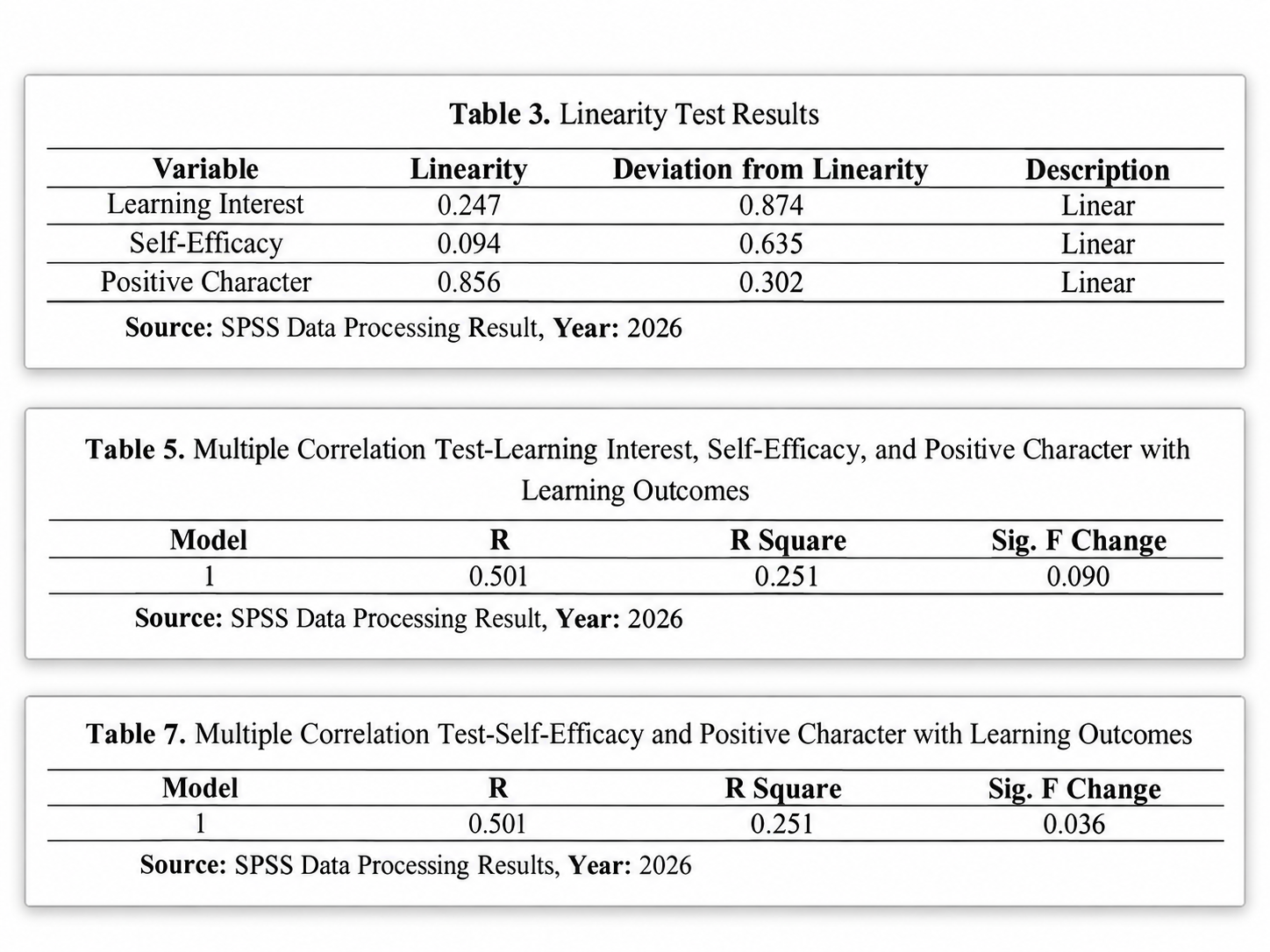
This study used a quantitative correlational approach to examine the associations of learning interest, self-efficacy, and positive character with mathematics learning outcomes among Grade XI.A students at UPTD SMA Negeri Matakali in the 2025/2026 academic year. Twenty-six students participated in the study. Data were collected through three questionnaires-covering learning interest, self-efficacy, and positive character-together with documented mathematics scores for the current semester. The researchers then analyzed the data using descriptive statistics, normality and linearity tests, Pearson product-moment correlation, and multiple correlation analysis. The results indicated a significant association between learning interest and mathematics learning outcomes (r = 0.429, p = 0.029) and a comparable association between self-efficacy and mathematics learning outcomes (r = 0.427, p = 0.030). Positive character, by contrast, was not significantly associated with mathematics learning outcomes (r = -0.036, p = 0.863). When the three variables were considered together, they showed no significant joint association with mathematics learning outcomes. These findings indicate that, within this sample, learning interest and self-efficacy were significantly associated with mathematics learning outcomes, whereas positive character and the combined three-variable model were not. Because the sample was limited to 26 students from Grade XI.A, the findings should be generalized beyond this group with caution.
ABSTRAK
Penelitian ini menggunakan pendekatan kuantitatif korelasional untuk mengkaji hubungan minat belajar, self-efficacy, dan positive character dengan hasil belajar matematika siswa kelas XI.A UPTD SMA Negeri Matakali pada tahun ajaran 2025/2026. Sebanyak 26 siswa berpartisipasi dalam penelitian ini. Data dikumpulkan melalui tiga angket yang mengukur minat belajar, self-efficacy, dan positive character, serta dokumentasi nilai matematika pada semester berjalan. Selanjutnya, data dianalisis menggunakan statistik deskriptif, uji normalitas dan linearitas, korelasi product-moment Pearson, serta analisis korelasi berganda. Hasil penelitian menunjukkan adanya hubungan yang signifikan antara minat belajar dan hasil belajar matematika (r = 0,429; p = 0,029), serta hubungan yang serupa antara self-efficacy dan hasil belajar matematika (r = 0,427; p = 0,030). Sebaliknya, positive character tidak menunjukkan hubungan yang signifikan dengan hasil belajar matematika (r = -0,036; p = 0,863). Ketika ketiga variabel dianalisis secara bersama-sama, tidak ditemukan hubungan simultan yang signifikan dengan hasil belajar matematika. Temuan ini menunjukkan bahwa, pada sampel penelitian ini, minat belajar dan self-efficacy berhubungan secara signifikan dengan hasil belajar matematika, sedangkan positive character dan model gabungan ketiga variabel tidak menunjukkan hubungan yang signifikan. Karena sampel penelitian hanya terdiri atas 26 siswa kelas XI.A, generalisasi temuan di luar kelompok ini perlu dilakukan secara hati-hati.
Downloads
References
Bandura, A. (1997). Self-efficacy : The Exercise of Control. New York : W.H. Freeman.
Fitriani, R. N., & Pujiastuti, H. (2021). Pengaruh Self-efficacy terhadap Hasil Belajar Matematika. Jurnal Cendekia: Jurnal Pendidikan Matematik, 5(3), 2793–2801. https://doi.org/10.31004/cendekia.v5i3.803
Hasbi, A. Z. El, Damayanti, R., Hermina, D., & Mizani, H. (2023). Penelitian Korelasional (Metodologi Penelitian Pendidikan). Al-Furqan : Jurnal Agama, Sosial, dan Budaya, 2(6), 784–808. https://publisherqu.com/index.php/Al-Furqan/article/view/771
Hettinger, K., Lazarides, R., & Schiefele, U. (2023). Motivational Climate in Mathematics Classrooms: Teacher Self-efficacy for Student Engagement, Student- and Teacher-reported Emotional Support and Student Interest. ZDM – Mathematics Education, 55, 413–426. https://doi.org/10.1007/s11858-022-01430-x
Hurlock, E. B. (1978). Child Development (6th ed.). McGraw-Hill.
Iskandar, M. T., Sasmita, K., & Tatminingsih, S. (2022). Pengaruh Minat Belajar dan Efikasi Diri terhadap Hasil Belajar IPS Siswa Sekolah Dasar. Jurnal Elementaria Edukasia, 5(1), 36–47. https://www.academia.edu/download/89209704/2503.pdf
Ismayanti, W., Santosa, C. A. H. F., & Rafianti, I. (2022). Minat Belajar, Efikasi Diri, dan Kemampuan Berpikir Kritis Berpengaruh terhadap Hasil Belajar Matematika Siswa. Jurnal Educatio, 8(3), 943–952. https://doi.org/10.31949/educatio.v8i3.2847
Nurhayati, N., Lestari, T., Afgani, M. W., & Isnaini, M. (2025). Correlational Research (Penelitian Korelasional). J-CEKI: Jurnal Cendekia Ilmia, 4(3), 8–19. https://al-haramjournal.co.id/J-CEKI/article/view/6706/6426
Obafemi, K. E., Saadu, U. T., Adesokan, A., Yahaya, O., Sulaimon, J. T., Obafemi, T. O., & Yakubu, F. M. (2023). Self-efficacy as a Correlate of Pupils’ Academic Achievement in Mathematics. Indonesian Journal of Teaching in Science, 3(2), 113–120. https://doi.org/10.17509/ijotis.v3i2.59775
Oppong-Gyebi, E., Dissou, Y. A., Brantuo, W. A., Maanu, V., Boateng, F. O., & Adu-Obeng, B. (2023). Improving STEM Mathematics Achievement through Self-efficacy, Student Perception, and Mathematics Connection: The mediating Role of Student Interest. Journal of Pedagogical Research, 7(4), 186–202. https://doi.org/10.33902/JPR.202321085
Putri, A. A., & Dewi, R. M. (2022). Pengaruh Manajemen Waktu dan Efikasi Diri pada Hasil Belajar Ekonomi Kelas X SMAN 1 Sidoarjo. Oikos: Jurnal Kajian Pendidikan Ekonomi dan Ilmu Ekonomi, 6(2), 214–225. https://doi.org/10.23969/oikos.v6i2.5635
Sholikhah, L. F., & Anasrulloh, M. (2025). Analisis Faktor-Faktor yang Memengaruhi Minat Belajar Siswa Mata Pelajaran IPS. Edunomic: Jurnal Ilmiah Pendidikan Ekonomi Fakultas Keguruan dan Ilmu Pendidikan, 13(2), 166–175. https://doi.org/10.33603/ejpe.v13i2.10542
Sriyanti, A., Rahmatia, R., Latuconsina, N. K., Suharti, S., & Amin, R. (2021). Pengaruh Motivasi Belajar dan Efikasi Diri terhadap Prestasi Belajar Matematika. Histogram: Jurnal Pendidikan Matematika, 5(2), 289–302. https://journal.matappa.ac.id/index.php/histogram/en/article/download/1229/pdf/5996
Waruwu, F. (2024). Peran Pendidikan Karakter dalam Membentuk Sikap Positif terhadap Belajar Anak di Sekolah. Jurnal Review Pendidikan dan Pengajaran, 7(3), 11002–11008. https://doi.org/10.31004/jrpp.v7i3.32136
Yandi, A., Putri, A. N. K., & Putri, Y. S. K. (2023). Faktor-Faktor yang Mempengarui Hasil Belajar Peserta Didik (Literature Review). Jurnal Pendidikan Siber Nusantara (JPSN), 1(1), 13–24. https://doi.org/10.38035/jpsn.v1i1.14
Zulmaizar, M. M., Syah, A., & Putri, A. N. A. (2025). Pengaruh Minat dan Konsentrasi Siswa terhadap Hasil Belajar Matematika Setelah Menerapkan Ice Breaking pada Kelas 7 SMP Negeri 1 Wonomulyo. Journal Peqguruang: Conference Series, 7(2), 567–571. https://journal.lppm-unasman.ac.id/index.php/peqguruang/article/download/5391/pdf_1
Downloads
Published
Issue
Section
License
Copyright (c) 2026 Sukmawati, Miftahul Jannah, Muhammad Ali P, Reski Rahman

This work is licensed under a Creative Commons Attribution-NonCommercial-NoDerivatives 4.0 International License.
Please find the rights and licenses in Histogram: Jurnal Pendidikan Matematika. By submitting the article/manuscript, the author(s) accept this policy.
1. License
The non-commercial use of the article will be governed by the Creative Commons Attribution license as currently displayed on Creative Commons Attribution-ShareAlike 4.0 International.
2. Author's Warranties
The author warrants that the article is original, written by a stated author(s), has not been published before, contains no unlawful statements, does not infringe the rights of others, is subject to copyright that is vested exclusively in the author and free of any third party rights, and that any necessary written permissions to quote from other sources have been obtained by the author(s).
3. User Rights
Histogram: Jurnal Pendidikan Matematika's spirit is to disseminate articles published for free. Under the Creative Commons license, Histogram: Jurnal Pendidikan Matematika permits users to copy, distribute, display, and perform the work for non-commercial purposes only. Users will also need to attribute authors and Histogram: Jurnal Pendidikan Matematika when distributing works in the journal.
4. Rights of Authors
Authors retain all their rights to the published works, such as (but not limited to) the following rights;
- Copyright and other proprietary rights relating to the article, such as patent rights,
- The right to use the substance of the article in one's future works, including lectures and books,
- The right to reproduce the article for one's purposes,
- The right to self-archive the article,
- The right to enter into separate, additional contractual arrangements for the non-exclusive distribution of the article's published version (e.g., post it to an institutional repository or publish it in a book), with an acknowledgment of its initial publication in this journal (Histogram: Jurnal Pendidikan Matematika).
5. Co-Authorship
If other authors jointly prepared the article, any author submitting the manuscript warrants that all co-authors have authorized them to agree on this copyright and license notice (agreement) on their behalf and agree to inform their co-authors of the terms of this policy. Histogram: Jurnal Pendidikan Matematika will not be held liable for anything arising from the author(s) internal dispute. Histogram: Jurnal Pendidikan Matematika will only communicate with the corresponding author.
6. Royalties
This agreement entitles the author to no royalties or other fees. To such an extent that it is legally permissible, the author waives their right to collect royalties relative to the article regarding any use by Histogram: Jurnal Pendidikan Matematika.
7. Miscellaneous
Histogram: Jurnal Pendidikan Matematika will publish the article (or have it published) in the journal if the editorial process is completed. Histogram: Jurnal Pendidikan Matematika h editors may modify the article to a style of punctuation, spelling, capitalization, referencing, and usage that deems appropriate. The author acknowledges that the article may be published to be publicly accessible, and such access will be free of charge for the readers, as mentioned in point 3.