IMPASSES IN MATHEMATICAL PROBLEM SOLVING: TYPOLOGIES AND RESOLUTION MECHANISMS IN PRODUCTIVE STRUGGLE
DOI:
https://doi.org/10.31100/histogram.v10i2.4751Keywords:
Productive Struggle, Cognitive Impasse, Mathematical Problem Solving, Teacher FacilitationAbstract
ABSTRACT
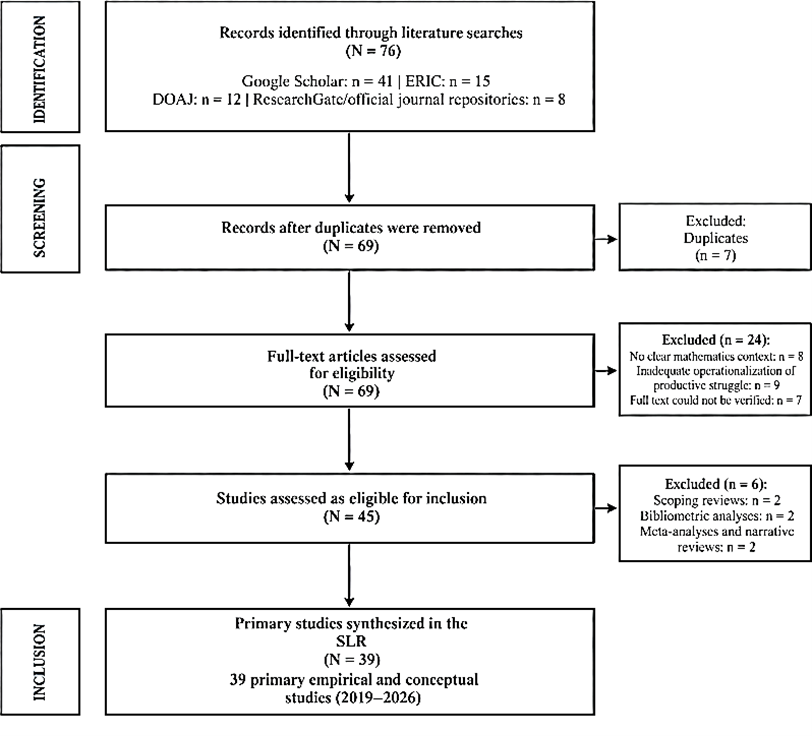
Productive struggle is a cognitive process in which students engage with challenging mathematical tasks, experience a temporary cognitive impasse (the stuck phase), and eventually find a way forward without immediate direct teacher assistance. This study presents a systematic literature review of primary studies on productive struggle published between 2019 and 2026, with particular attention to impasse phases and their resolution mechanisms. Following the PRISMA 2020 protocol, literature was searched across Google Scholar, ERIC, DOAJ, and official journal repositories. Of 76 initially identified articles, 39 studies met the inclusion criteria. Narrative thematic synthesis focused on three areas: 1) the methodological landscape and contextual distribution of research, 2) the typology of impasses and related mathematical task-design features, and 3) teacher facilitation dynamics in impasse resolution. The findings show a dominance of qualitative methods (61.5%), middle school student participants (35.9%), and limited research in culturally contextualized educational settings. The study highlights implications for designing contextualized geometry tasks under Indonesia’s Kurikulum Merdeka, particularly through the integration of ethnomathematics.
ABSTRAK
Productive struggle merupakan proses kognitif ketika siswa terlibat dalam tugas matematika yang menantang, mengalami kebuntuan kognitif, dan berupaya menemukan jalan keluar tanpa bantuan langsung dari guru. Penelitian ini menyajikan systematic literature review terhadap studi primer mengenai productive struggle yang diterbitkan pada periode 2019–2026, dengan perhatian khusus pada kebuntuan yang dialami siswa dan mekanisme penyelesaiannya. Mengikuti protokol PRISMA 2020, penelusuran literatur dilakukan melalui Google Scholar, ERIC, DOAJ, dan repositori jurnal resmi. Dari 76 artikel yang teridentifikasi pada tahap awal, sebanyak 39 studi memenuhi kriteria inklusi. Sintesis tematik naratif difokuskan pada tiga aspek, yaitu: 1) lanskap metodologis dan distribusi kontekstual penelitian, 2) tipologi kebuntuan dan karakteristik desain tugas matematika yang berkaitan, dan 3) dinamika fasilitasi guru dalam penyelesaian kebuntuan. Hasil menunjukkan dominasi metode kualitatif (61,5%), partisipan siswa sekolah menengah pertama (35,9%), serta masih terbatasnya penelitian dalam konteks pendidikan berbasis budaya. Penelitian ini menyoroti implikasi bagi perancangan tugas geometri kontekstual dalam Kurikulum Merdeka, khususnya melalui integrasi etnomatematika.
Downloads
References
Abida, A. S., Suyitno, A., & Kharisudin, I. (2023). Analisis Kemampuan Pemecahan Masalah Siswa Dalam Pembelajaran Creative Problem Solving Berbantuan Modul Pembelajaran. Histogram : Jurnal Pendidikan Matematika, 7(2), 244–265. https://journal.matappa.ac.id/index.php/histogram/article/view/3456
Baker, K., Clark, M., & Gallagher, D. M. (2024). Together in a Productive Struggle Unpacking Student and Teacher Productive Struggle in Mathematics. Electronic Journal for Research in Science and Mathematics Education, 27(4), 107–117. https://ejrsme.icrsme.com/article/view/22822
Baker, K., Jessup, N. A., Jacobs, V. R., Empson, S. B., & Joan, C. (2020). Productive Struggle in Action. Mathematics Teacher: Learning and Teaching PK-12, 113(5), 361–367. https://doi.org/10.5951/MTLT.2019.0060
Biccard, P. (2024). Productive Struggle in Mathematical Modelling. The Mathematics Enthusiast, 21(1), 99–112. https://doi.org/10.54870/1551-3440.1620
Bolyard, J., Curtis, R., & Cairns, D. (2024). Learning to Struggle: Supporting Middle-Grade Teachers’ Understanding of Productive Struggle in STEM Teaching and Learning. Canadian Journal of Science Mathematics and Technology Education, 23(4), 687–702. https://link.springer.com/article/10.1007/s42330-023-00302-0
Casler-Failing, S. L. (2024). Facilitating Productive Struggle in an Online Secondary Education Mathematics Methods Course: Experiences of Pre-Service Teachers. Journal of Teaching and Learning, 18(1), 56–74. https://doi.org/10.22329/jtl.v18i1.7813
DiNapoli, J. (2023). Distinguishing Between Grit, Persistence, and Perseverance for Learning Mathematics with Understanding. Education Sciences, 13(4), 1–27. https://doi.org/10.3390/educsci13040402
DiNapoli, J., & Miller, E. K. (2022). Recognizing, Supporting, and Improving Student Perseverance in Mathematical Problem-Solving: The Role of Conceptual Thinking Scaffolds. The Journal of Mathematical Behavior, 66, 100965. https://doi.org/10.1016/j.jmathb.2022.100965
Dinapoli, M. A. (2021). Eroding Opportunity: COVID-19’s Toll on Student Access to Well-Prepared and Diverse Teachers. Learning Policy Institute. https://learningpolicyinstitute.org/blog/covid-eroding-opportunity-student-access-prepared-diverse-teachers
Dixon, J., & Mahoney, T. (2024). Productive Struggle in Mathematics: Utilising Challenging Tasks to Establish Richer Mathematical Learning Experiences. Australian Mathematics Education Jurnal, 29(1), 10–15. https://search.informit.org/doi/abs/10.3316/informit.T2025081300006990380522380
Estrella, S., Zakaryan, D., & Espinoza, G. (2020). How Teachers Learn to Maintain the Cognitive Demand of Tasks Through Lesson Study. Journal of Mathematics Teacher Education, 23, 293–310. https://doi.org/10.1007/s10857-018-09423-y
George Polya. (2014). How to Solve It: A New Aspect of Mathematical Method. Princeton University Press.
Hakim, R. A., Muharram, M. R. W., & Muharram, M. (2025). Pengaruh Pendekatan Open Ended berbasis Productive Struggle terhadap Literasi Matematis Siswa di Sekolah Dasar. Jurnal Syntax Imperatif: Jurnal Ilmu Sosial dan Pendidikan, 6(4), 1008–1019. https://doi.org/10.54543/syntaximperatif.v6i4.768
Kartal, O., Popovic, G., Morrisse, S., & Holifield, L. (2017). Students’ Productive Struggle through Mathematical Modeling. Illinois Mathematics Teacher, 64(1), 1–9. https://www.academia.edu/download/54135060/IMT_Aug2017.pdf
Khalil, I. A. (2024). The Effectiveness of an Education Program in Developing Mathematical Achievement as Well as Developing Productive Struggle Among Students of Intermediate Stage. International Journal for Research in Education Program in Developing Productive Struggle Among Students of Intermediate Stage, 48(1), 1–34. https://doi.org/10.36771/ijre.48.1.24-pp66-98
Khalil, I., AL-Otaibi, A., Almughyirah, S., & Almalky, M. (2025). How do Students Evaluate their Teachers’ Support for Productive Struggle in Learning Mathematics? A Mixed-Methods Study. Cogent Education, 12(1), 1–17. https://doi.org/10.1080/2331186X.2024.2442234
Khotimah, H. (2021). Perkembangan Literasi Matematika di Indonesia. Seminar Nasional Pendidikan Matematika. https://jurnal.fkip.unmul.ac.id/index.php/psnpm/article/view/1033/694
Kyriakides, L., Christoforidou, M., Panayiotou, A., & Creemers, B. P. M. (2017). The Impact of a Three-Year Teacher Professional Development Course on Quality of Teaching: Strenghts and Limitations of The Dynamic Approach. European Journal of Teacher Educational, 40(4), 465–486. https://doi.org/10.1080/02619768.2017.1349093
Lambert, R., & Schuck, R. (2021). “The Wall Now Between Us”: Teaching Math to Students with Disabilities During the COVID Spring of 2020. The Asia-Pacific Education Researcher, 30(3), 289–298. https://doi.org/10.1007/s40299-021-00568-8
Lambert, R., & Tan, P. (2020). Does Disability Matter in Mathematics Educational Research? A Critical Comparison of Research on Students with and without Disabilities. Mathematics Education Research Journal, 32, 5–35. https://link.springer.com/article/10.1007/s13394-019-00299-6
Masitoh, S., Herman, T., & Hasanah, A. (2024). Differences in Mathematical Adaptive Reasoning Abilities and Productive Struggle Achievement through Problem-Based Learning. Jurnal Pendidikan MIPA, 25(3), 1037–1050. https://doi.org/10.23960/jpmipa/v25i3.pp1037-1050
Mefiana, S. A., Herman, T., Hasanah, A., Samosir, C. M., & Melani, R. (2023). Pemahaman Matematis Siswa Ditinjau dari Daya Juang Produktif. Jurnal Cendekia: Jurnal Pendidikan Matematika, 7(3), 2368–2381. https://doi.org/10.31004/cendekia.v7i3.2552
Melani, R., Herman, T., Hasana, A., Mefiana, S. A., & Samosir, C. M. (2023). Kemampuan Membuat Model Matematika dan Daya Juang Produktif Siswa SMP dalam Menyelesaikan Soal Pemecahan Masalah. Jurnal Cendekia: Jurnal Pendidikan Matematika, 7(3), 2391–2404. https://doi.org/10.31004/cendekia.v7i3.2545
Mufliva, R., Turmudi, T., Herman, T., Iriawan, S. B., & Fitriani, A. D. (2024). Problem-Solving Skills and Productive Struggle of Students in Solving Mathematical Problems in Elementary School. Southeast Asia Mathematics Education Journal, 14(1), 69–82. https://doi.org/10.46517/seamej.v14i1.376
Mufliva, R., Turmudi, T., Prabawanto, S., & Riyadi, A. R. (2025). Global Research Trends on Productive Struggle Students in Primary Scholl: Bibliometric Analysis (2016-2025) using VOSviewer. Salud, Ciencia y Tecnología, 5, 1–14. https://doi.org/10.56294/saludcyt20251716
Murdoch, D., English, A. R., Hintz, A., & Tyson, K. (2020). Feeling Heard: Inclusive Education, Transformative Learning, and Productive Struggle. Educational Theory, 70(5), 653–679. https://doi.org/10.1111/edth.12449
Oktavia, A. N., Herman, T., & Hasanah, A. (2026). Exploring Students’ Argumentation Ability in Mathematical Problem Solving Based on Levels of Productive Struggle. Jurnal Pembelajaran, Bimbingan, dan Pengelolaan Pendidikan, 6(5), 1–11. https://doi.org/10.17977/um065.v6.i5.2026.7
Page, M. J., McKenzie, J. E., Bossuyt, P. M., Boutron, I., Hoffmann, T. C., Mulrow, C. D., Shamseer, L., Tetzlaf, J. M., Akl, E. A., Brennan, S. E., Chou, R., Glanville, J., Grimshaw, J. M., Hróbjartsson, A., Lalu, M. M., Li, T., Loder, E. W., Mayo-Wilson, E., McDonald, S., … Moher, D. (2021). The PRISMA 2020 Statement: An Updated Guideline for Reporting Systematic Reviews. PLOS Medicine, 18(3), 1–15. https://doi.org/10.1371/journal.pmed.1003583
Pasquale, M. (2016). Productive Struggle in Mathematics. https://files.eric.ed.gov/fulltext/ED571660.pdf
Popay, J., Roberts, H., Sowden, A., Petticrew, M., Arai, L., Rodgers, M., Britten, N., & Duffy, K. R. and S. (2006). Guidance on the Conduct of Narrative Synthesis in Systematic Reviews: A Product from the ESRC Methods Programme.
Putro, Y. T. M. (2021). Asesmen Kesulitan Belajar Matematika pada Sekolah Dasar. 1–7. http://eprints.umsida.ac.id/id/eprint/8176
Russo, J., Bobis, J., Downton, A., Livy, S., & Sullivan, P. (2021). Primary Teacher Attitudes towards Productive Struggle in Mathematics in Remote Learning versus Classroom-Based Settings. Education Sciences, 11(2), 1–13. https://doi.org/10.3390/educsci11020035?urlappend=%3Futm_source%3Dresearchgate.net%26utm_medium%3Darticle
Russo, J., BobiS, J., Sullivan, P., Downton, A., Livy, S., McCormick, M., & Hughe, S. (2020). Exploring The Relationship Between Teacher Enjoyment of Mathematics, Their Attitudes Towards Student Struggle and Instructional Time Amongst Early Years Primary Teachers. Teaching and Teacher Education, 88, 1–9. https://doi.org/10.1016/j.tate.2019.102983
Safak, R., Karatas, S., & Karatas, V. (2021). Productive Struggle in Learning Mathematics: Preservice Elementary and Middle School Teachers’ Lesson Plans. Proceedings of the 43rd Annual Meeting of the North American Chapter of the International Group for the Psychology of Mathematics Education, 1126–1133.
Salazar, C. L. (2022). Influence of Productive Struggle in Mathematics to The 21st Century Learners. Docens Series in Education, 3, 71–92. https://doi.org/10.20319/dv3.7192
Samosir, C. M., Herman, T., Hasanah, A., Melani, R., & Mefiana, S. A. (2023). Penyelesaian Soal Matematika Kontekstual Siswa Kelas VII Berdasarkan Struktur Kalimat Ditinjau dari Daya Juang Produktif. Jurnal Cendekia : Jurnal Pendidikan Matematika, 7(3), 2581–2594. https://doi.org/10.31004/cendekia.v7i3.2507
Sayed, H. M. S. (2022). Use of the Geogbra in Developing Productive Struggle and Deep Understanding in The Geometry and Measurement Unit of The First Grade Preparatory Students in Assiut Governorate. Journal of Mathematics Education, 25(3), 139–179. https://journals.ekb.eg/article_243263.html
Sayster, A. (2023). High-school Students’ Productive Struggles During the Simplification of Trigonometrical Expressions and the Proving of Trigonometrical identities. [University of Cape Town]. https://shocklab.net/wp-content/uploads/2026/03/Sayster_Anthony_PhD_2023.pdf
Sayster, A., & Mhakure, D. (2020a). Students’ Productive Struggles in Mathematics Learning. In Pedagogy in Basic and Higher Education - Current Developments and Challenges. IntechOpen. https://doi.org/10.5772/intechopen.90802
Sayster, A., & Mhakure, D. (2020b). Students’ Productive Struggles in Mathematics Learning. Pedagogy in Basic and Higher Education - Current Developments and Challenges, 1–19. https://doi.org/10.20319/dv3.7192
Townsend, C., Slavit, D., & McDuffie, A. R. (2018). Supporting All Learners in Productive Struggle. Mathematics Teaching in the Middle School, 23(4), 216–224. https://doi.org/10.5951/mathteacmiddscho.23.4.0216
Trinter, C. P., & Hughes, H. E. (2021). Teachers as Curriculum Designers: Inviting Teachers into the Productive Struggle. Research in Middle Level Education, 44(3), 1–16. https://doi.org/10.1080/19404476.2021.1878417
VanLehn, K., Burkhard, H., Cheema, S., Kang, S., Pead, D., Schoenfeld, A., & Wetze, J. (2021). Can an Orchestration System Increase Collaborative, Productive Struggle in Teaching-by-Eliciting Classrooms. Interactive Learning Environments, 29(6), 987–1005. https://doi.org/10.1080/10494820.2019.1616567
Vazquez, S. R., Ermeling, B. A., & Ramirez, G. (2020). Parental Beliefs on the Efficacy of Productive Struggle and Their Relation to Homework-Helping Behavior. Journal for Research in Mathematics Education, 51(2), 179–203. https://pubs.nctm.org/view/journals/jrme/51/2/article-p179_1.xml
Warshauer, H. K. (2015). Productive Struggle in Middle School Mathematics Classrooms. Jurnal of Mathematics Teacher Education, 18, 375–400. https://link.springer.com/article/10.1007/s10857-014-9286-3
Weingarden, M. (2025). Exploring Pre-service Mathematics Teachers’ Perspectives on Balancing Student Struggle and Concept Attention. Teaching and Teacher Education, 165, 1–17. https://www.sciencedirect.com/science/article/pii/S0742051X25002203
Yastuti, N. L., Rizal, M., Murdiana, I. N., & Ismaimuza, D. (2025). Profil Pemecahan Masalah Peserta Didik Ditinjau dari Self Efficacy. Histogram: Jurnal Pendidikan Matematika, 9(2), 55–67. https://doi.org/10.31100/histogram.v9i2.3497
Young, J., Bevan, D., & Sanders, M. (2024). How Productive is The Productive Struggle? Lessons Learned from a Scoping Review. International Journal of Education in Mathematics, Science and Technology, 12(2), 470–495. https://doi.org/10.46328/ijemst.3364
Young, J. R., Sanders, M., Bevan, D., & Amin, S. (2025). What Exactly is the Productive Struggle? Lessons Learned from a Content Analysis of the Mathematics Education Literature. International Journal of Education in Mathematics, Science, and Technology (IJEMST, 13(5), 1039–1063. https://doi.org/10.46328/ijemst.5696
Downloads
Published
Issue
Section
License
Copyright (c) 2026 Sayida Nafisa Azmi, Imam Sujadi, Ikrar Pramudya

This work is licensed under a Creative Commons Attribution-NonCommercial-NoDerivatives 4.0 International License.
Please find the rights and licenses in Histogram: Jurnal Pendidikan Matematika. By submitting the article/manuscript, the author(s) accept this policy.
1. License
The non-commercial use of the article will be governed by the Creative Commons Attribution license as currently displayed on Creative Commons Attribution-ShareAlike 4.0 International.
2. Author's Warranties
The author warrants that the article is original, written by a stated author(s), has not been published before, contains no unlawful statements, does not infringe the rights of others, is subject to copyright that is vested exclusively in the author and free of any third party rights, and that any necessary written permissions to quote from other sources have been obtained by the author(s).
3. User Rights
Histogram: Jurnal Pendidikan Matematika's spirit is to disseminate articles published for free. Under the Creative Commons license, Histogram: Jurnal Pendidikan Matematika permits users to copy, distribute, display, and perform the work for non-commercial purposes only. Users will also need to attribute authors and Histogram: Jurnal Pendidikan Matematika when distributing works in the journal.
4. Rights of Authors
Authors retain all their rights to the published works, such as (but not limited to) the following rights;
- Copyright and other proprietary rights relating to the article, such as patent rights,
- The right to use the substance of the article in one's future works, including lectures and books,
- The right to reproduce the article for one's purposes,
- The right to self-archive the article,
- The right to enter into separate, additional contractual arrangements for the non-exclusive distribution of the article's published version (e.g., post it to an institutional repository or publish it in a book), with an acknowledgment of its initial publication in this journal (Histogram: Jurnal Pendidikan Matematika).
5. Co-Authorship
If other authors jointly prepared the article, any author submitting the manuscript warrants that all co-authors have authorized them to agree on this copyright and license notice (agreement) on their behalf and agree to inform their co-authors of the terms of this policy. Histogram: Jurnal Pendidikan Matematika will not be held liable for anything arising from the author(s) internal dispute. Histogram: Jurnal Pendidikan Matematika will only communicate with the corresponding author.
6. Royalties
This agreement entitles the author to no royalties or other fees. To such an extent that it is legally permissible, the author waives their right to collect royalties relative to the article regarding any use by Histogram: Jurnal Pendidikan Matematika.
7. Miscellaneous
Histogram: Jurnal Pendidikan Matematika will publish the article (or have it published) in the journal if the editorial process is completed. Histogram: Jurnal Pendidikan Matematika h editors may modify the article to a style of punctuation, spelling, capitalization, referencing, and usage that deems appropriate. The author acknowledges that the article may be published to be publicly accessible, and such access will be free of charge for the readers, as mentioned in point 3.