PERSEPSI MAHASISWA TERHADAP KETERAMPILAN 4C MELALUI TUWEB PEMBELAJARAN MATEMATIKA ABAD KE-21
DOI:
https://doi.org/10.31100/histogram.v10i2.4680Keywords:
Student Perceptions, 4C Skills, Webinar Tutorial, 21st-Century LearningAbstract
ABSTRAK
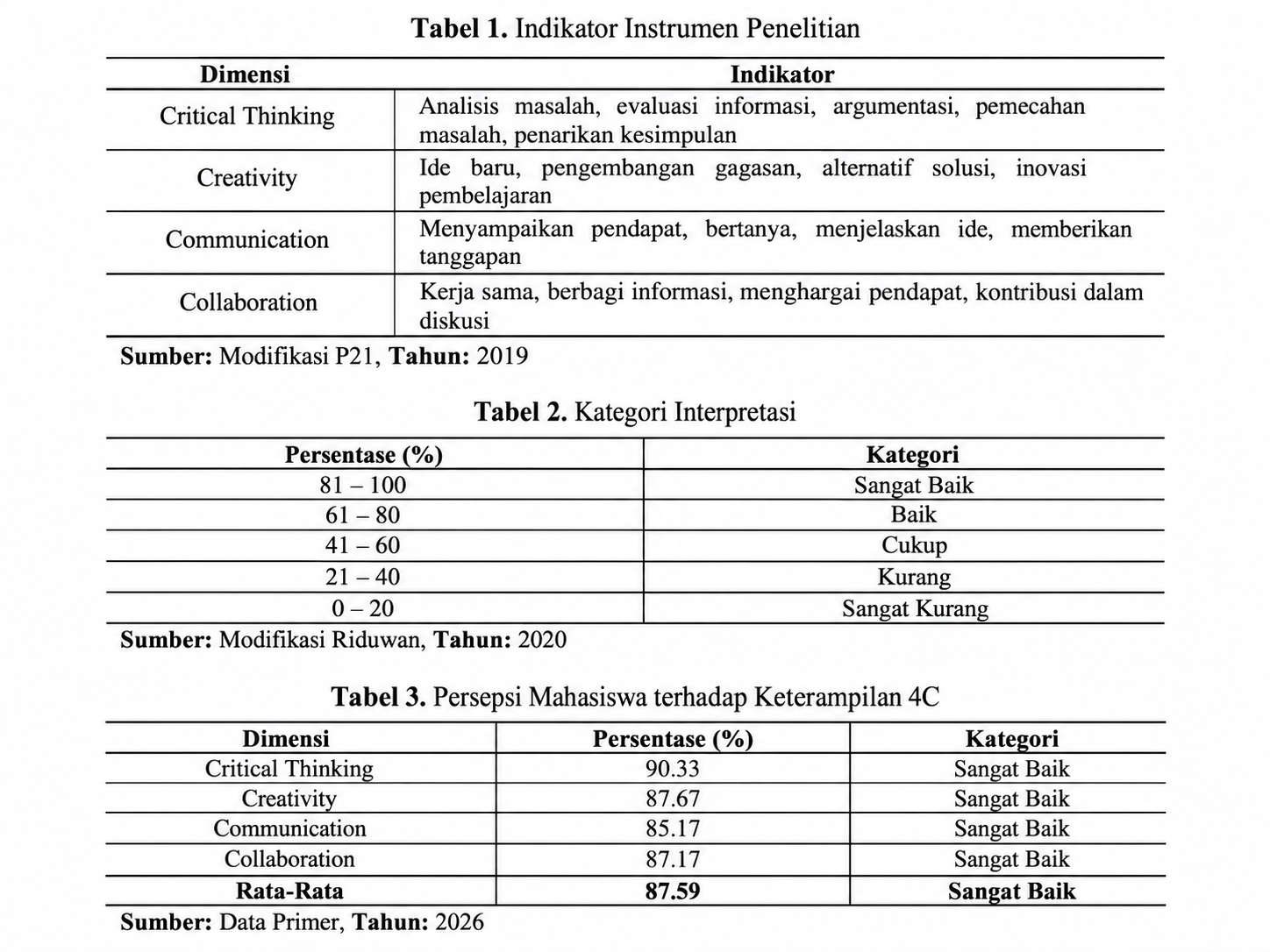
Pembelajaran jarak jauh melalui Tutorial Webinar (TuWeb) memberikan kesempatan kepada mahasiswa untuk berinteraksi, berdiskusi, menyampaikan pendapat, dan menganalisis permasalahan pembelajaran. Namun, belum diketahui secara jelas bagaimana mahasiswa mempersepsikan keterampilan 4C yang mereka alami selama mengikuti TuWeb pada mata kuliah Tren Pembelajaran Matematika Abad ke-21. Penelitian ini bertujuan untuk mendeskripsikan persepsi mahasiswa terhadap keterampilan 4C yang meliputi critical thinking, creativity, communication, dan collaboration selama mengikuti TuWeb. Penelitian menggunakan pendekatan deskriptif kuantitatif dengan metode survei. Responden penelitian berjumlah 20 mahasiswa yang mengikuti TuWeb selama satu semester. Data dikumpulkan melalui angket skala Likert yang mencakup empat dimensi keterampilan 4C dan dua pertanyaan terbuka sebagai data pendukung. Data kuantitatif dianalisis secara deskriptif melalui perhitungan persentase pada setiap dimensi, sedangkan tanggapan terbuka dianalisis dengan mengelompokkan respons berdasarkan tema yang muncul. Hasil penelitian menunjukkan bahwa persepsi mahasiswa terhadap keterampilan 4C berada pada kategori sangat baik dengan persentase rata-rata sebesar 87,59%. Critical thinking memperoleh persentase tertinggi sebesar 90,33%, diikuti creativity sebesar 87,67%, collaboration sebesar 87,17%, dan communication sebesar 85,17%. Tanggapan terbuka menunjukkan bahwa diskusi, presentasi, tanya jawab, dan analisis permasalahan merupakan aktivitas yang paling banyak dirasakan mahasiswa dalam memberikan ruang untuk menggunakan keterampilan 4C selama mengikuti TuWeb. Hasil penelitian memberikan gambaran bahwa mahasiswa memiliki persepsi sangat baik terhadap keterampilan 4C yang muncul dalam aktivitas pembelajaran melalui TuWeb.
ABSTRACT
Distance learning through Webinar Tutorials (TuWeb) gives students opportunities to interact, discuss, express opinions, and analyze learning problems. However, it remains unclear how students perceive the 4C skills they experience while participating in TuWeb in the 21st-Century Mathematics Learning Trends course. This study aimed to describe students' perceptions of the 4C skills, consisting of critical thinking, creativity, communication, and collaboration, during their participation in TuWeb. The study employed a descriptive quantitative approach using a survey method. The participants were 20 students who attended TuWeb for one semester. Data were collected through a Likert-scale questionnaire covering the four dimensions of 4C skills, along with two open-ended questions as supporting data. Quantitative data were analyzed descriptively by calculating the percentage for each dimension, while open-ended responses were analyzed by grouping them into emerging themes. The results showed that students' perceptions of the 4C skills were in the very good category, with an average percentage of 87.59%. Critical thinking obtained the highest percentage at 90.33%, followed by creativity at 87.67%, collaboration at 87.17%, and communication at 85.17%. Open-ended responses indicated that discussions, presentations, question-and-answer sessions, and problem analysis were the activities students most frequently identified as providing opportunities to use 4C skills during TuWeb. These findings indicate that students had very positive perceptions of the 4C skills reflected in TuWeb learning activities.
Downloads
References
Alpianoor, A., & Wardhani, D. F. (2025). Analisis Kecepatan Internet dan Produktivitas Mahasiswa dalam Pembelajaran Daring. JUTECH: Journal Education and Technology, 6(1), 35–49. https://doi.org/10.31932/jutech.v6i1.4750
Arsanti, M., Zulaeha, I., Subiyantoro, S., & S, N. H. (2021). Tuntutan Kompetensi 4C Abad 21 dalam Pendidikan di Perguruan Tinggi untuk Menghadapi Era Society 5.0. Prosiding Seminar Nasional Pascasarjana, 4(1), 319–324. https://proceedings.unnes.ac.id/snpasca/article/view/895
Azzahara, J. S., & Lestari, A. (2026). Integrasi 4C (Critical Thinking, Creativity, Communication, Collaboration) dalam Pembelajaran Modern. Aliansi: Jurnal Hukum, Pendidikan dan Sosial Humaniora, 3(1), 14–22. https://doi.org/10.62383/aliansi.v3i1.1445
Bach, A., & Thiel, F. (2024). Collaborative Online Learning in Higher Education-Quality of Digital Interaction and Associations with Individual and Group-Related Factors. Frontiers in Education, 9, 1–12. https://doi.org/10.3389/feduc.2024.1356271
Fitriani, I. F., Wijayanti, K., Dewi, N. R., Mariani, S., & Agoestanto, A. (2024). Meta Analisis: Pengaruh Model Project Based Learning Berpendekatan STEM terhadap Kemampuan Berpikir Kritis Matematis Siswa. Histogram : Jurnal Pendidikan Matematika, 8(1), 169–181. https://doi.org/10.31100/histogram.v8i1.3340
Gegenfurtner, A., Alijagic, A., Gabel, S., & Keskin, O. (2026). Synchronous Online Learning Supports Cognitive and Affective Outcomes More than Traditional Face-to-Face and Asynchronous online Education: A Meta-analysis of Webinar. Learning and Individual Differences, 126. https://www.sciencedirect.com/science/article/pii/S1041608025002389
Gold, N. O., Coovadia, H., & Mahmood, T. (2025). Critical Thinking Development in a Quality Matters-Based Online Learning: Student Insights from a South African Higher Education Context. Frontiers in Education, 10, 1–19. https://doi.org/10.3389/feduc.2025.1642266
Guo, J., & Asmawi, A. (2024). An Investigation of Undergraduate Students’ Use of Communication Skills in Online EFL Learning. SAGE Open, 14(4), 1–14. https://doi.org/10.1177/21582440241293527
Irham, I., Tolla, I., & Jabu, B. (2022). Development of the 4C Teaching Model to Improve Students’ Mathematical Critical Thinking Skills. International Journal of Educational Methodology, 8(3), 493–504. https://doi.org/10.12973/ijem.8.3.493
Kaltsonoudi, K., Tsigilis, N., & Karteroliotis, K. (2022). Common Method Bias in Research Designs Using Self-Report Tools: Literature Overview and Recommended Remedies. Psychology: The Journal of the Hellenic Psychological Society, 27(1), 210–231. https://doi.org/10.12681/psyhps.30843
Le, S. (2023). Team-Based Learning in Online Education: The Development of Students’ Creative Thinking Skills in Digital art. Education and Information Technologies, 28, 14967–14986. https://doi.org/10.1007/s10639-023-11808-3
Manousou, E. (2025). Critical Thinking in Distance Education: The Challenges in a Decade (2016–2025) and the Role of Artificial Intelligence. Education Sciences, 15(6), 1–24. https://doi.org/10.3390/educsci15060757
Partnership for 21st Century Learning. (2019). Framework for 21st Century Learning.
Redmond, P., Alexsen, M., Maloney, S., Turner, J., Brown, A., Basson, M., Galligan, L., Lawrence, J., & Henderson, R. (2023). Student Perceptions of Online Engagement. Online Learning, 27(1), 383–403. https://doi.org/10.24059/olj.v27i1.3320
Riduwan. (2018). Skala Pengukuran Variabel-variabel Penelitian. Bandung: Alfabeta.
Rustanuarsi, R. (2023). Profil Keterampilan Kolaborasi Mahasiswa Calon Guru dalam Menyelesaikan Masalah Trigonometri. Histogram: Jurnal Pendidikan Matematika, 7(1), 694–704. https://doi.org/10.31100/histogram.v7i1.2808
Sricharoen, Y., & Adipat, S. (2024). Exploring Perceptions of 21st Century Skills Among Thai Grade 9 Students: A Focus on the 4Cs. Shanlax International Journal of Education, 12(4), 1–7. https://doi.org/10.34293/education.v12i4.7970
Sugiyono. (2022). Metode Penelitian Kuantitatif. Bandung : Alfabeta.
Unal, E., Yurdakul, S., & Maden, O. (2025). Importance of Sample Selection and Generalisability in Scientific Methodology. Turkish Journal of Medical Sciences, 55(5), 1344–1345. https://doi.org/10.55730/1300-0144.6089
Yuliana, Y., & Irawan, S. (2024). Analisis Tingkat Keterampilan 4C Peserta Didik Abad 21 Dalam Mendukung Pembelajaran Berdiferensiasi. Jurnal Pendidikan dan Konseling, 14(1), 121–133. https://doi.org/10.30829/al-irsyad.v14i1.20184
Downloads
Published
Issue
Section
License
Copyright (c) 2026 Amiruddin, Esterina Natalia Paindan

This work is licensed under a Creative Commons Attribution-NonCommercial-NoDerivatives 4.0 International License.
Please find the rights and licenses in Histogram: Jurnal Pendidikan Matematika. By submitting the article/manuscript, the author(s) accept this policy.
1. License
The non-commercial use of the article will be governed by the Creative Commons Attribution license as currently displayed on Creative Commons Attribution-ShareAlike 4.0 International.
2. Author's Warranties
The author warrants that the article is original, written by a stated author(s), has not been published before, contains no unlawful statements, does not infringe the rights of others, is subject to copyright that is vested exclusively in the author and free of any third party rights, and that any necessary written permissions to quote from other sources have been obtained by the author(s).
3. User Rights
Histogram: Jurnal Pendidikan Matematika's spirit is to disseminate articles published for free. Under the Creative Commons license, Histogram: Jurnal Pendidikan Matematika permits users to copy, distribute, display, and perform the work for non-commercial purposes only. Users will also need to attribute authors and Histogram: Jurnal Pendidikan Matematika when distributing works in the journal.
4. Rights of Authors
Authors retain all their rights to the published works, such as (but not limited to) the following rights;
- Copyright and other proprietary rights relating to the article, such as patent rights,
- The right to use the substance of the article in one's future works, including lectures and books,
- The right to reproduce the article for one's purposes,
- The right to self-archive the article,
- The right to enter into separate, additional contractual arrangements for the non-exclusive distribution of the article's published version (e.g., post it to an institutional repository or publish it in a book), with an acknowledgment of its initial publication in this journal (Histogram: Jurnal Pendidikan Matematika).
5. Co-Authorship
If other authors jointly prepared the article, any author submitting the manuscript warrants that all co-authors have authorized them to agree on this copyright and license notice (agreement) on their behalf and agree to inform their co-authors of the terms of this policy. Histogram: Jurnal Pendidikan Matematika will not be held liable for anything arising from the author(s) internal dispute. Histogram: Jurnal Pendidikan Matematika will only communicate with the corresponding author.
6. Royalties
This agreement entitles the author to no royalties or other fees. To such an extent that it is legally permissible, the author waives their right to collect royalties relative to the article regarding any use by Histogram: Jurnal Pendidikan Matematika.
7. Miscellaneous
Histogram: Jurnal Pendidikan Matematika will publish the article (or have it published) in the journal if the editorial process is completed. Histogram: Jurnal Pendidikan Matematika h editors may modify the article to a style of punctuation, spelling, capitalization, referencing, and usage that deems appropriate. The author acknowledges that the article may be published to be publicly accessible, and such access will be free of charge for the readers, as mentioned in point 3.